Can Receding Gums Really Grow Back? A Cleveland MD Says Yes, And It Comes Down To THIS One Thing Dentists Overlook

I'm a dermatologist. Not a dentist.
For 24 years, I've done one thing better than almost anything else in medicine: I rebuilding collagen. It's what I do every single day, firming sagging skin, smoothing wrinkles, lifting tissue that's lost its support. And one of the most powerful tools I use to do it is red light.
I never once thought about gums.
Until the night my mother called me crying.
Because what she told me on that phone call didn't add up. And when I went looking for why, I uncovered something that I believe the entire dental industry has gotten wrong for decades, something that's costing millions of people their natural teeth.
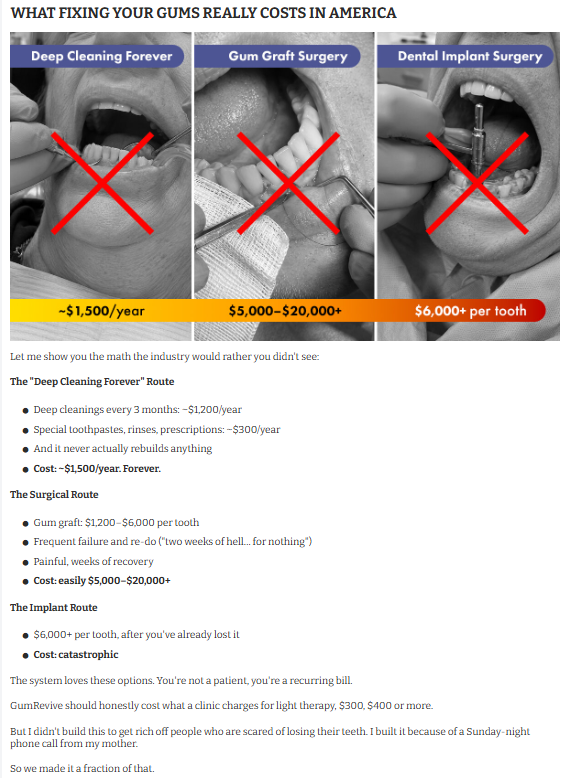
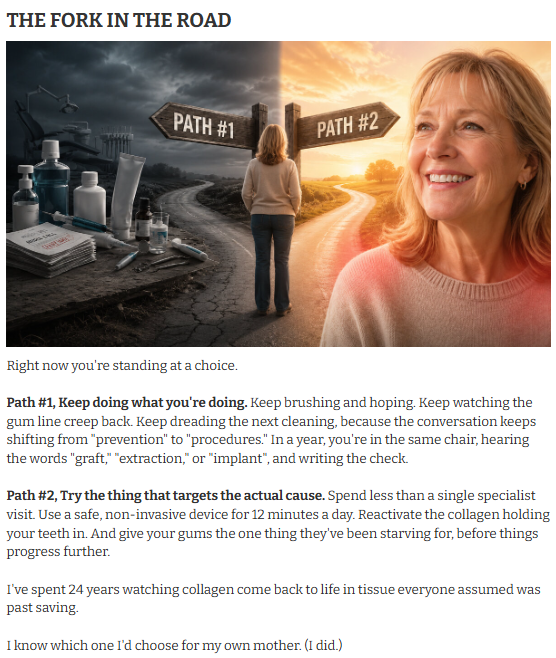
So if your gums bleed when you brush… if they're pulling back from your teeth… if a tooth has started to feel even slightly loose… or if a dentist has ever quoted you thousands of dollars for "deep cleanings," grafts, or extractions you can't afford…
Please read the next 4 minutes carefully. Because what saved my mother's teeth has nothing to do with brushing harder, and everything to do with something I see in my own practice every day.
My name is Dr. Elaine Mercer. Let me tell you about the phone call that started all of this.
THE PHONE CALL THAT BROKE MY HEART

It was a Sunday evening when my mother called me crying.
She'd just come back from a "routine" cleaning where a hygienist told her, almost casually, that she had "pockets," "bone loss starting," and that she'd "probably need to start thinking about implants or partials down the road."
She was 68. She had brushed twice a day her entire life. She was proud of her teeth.
"Elaine," she said, "I did everything right. I don't understand. They told me it's too late and gums don't grow back. What did I do wrong?"
I calmed her down. I told her I'd look into it.
But that one phrase kept nagging at me all night: gums don't grow back.
Because in my world, in dermatology, we say the opposite of tissue all the time. We firm it. We rebuild it. We lift it. I'd spent 24 years proving that collagen tissue can be brought back to life.
So I did something a dentist would never think to do.
I looked up what gums are actually made of.
And what I found stopped me cold.
THE THING DENTISTS NEVER TOLD YOU (BECAUSE THEY NEVER THOUGHT TO)
Here is the fact that changed everything for my mother, and for thousands of people since:
Your gums and the skin on your face are made of the exact same material, collagen.
The instant I read that, my stomach dropped. Because I rebuild collagen for a living.
I'd spent my entire career watching red light firm sagging skin… smooth wrinkles… lift tissue that had lost its support. I'd seen it with my own eyes, on thousands of patients, in my own clinic.
And now I was being told that the same collagen tissue, just located in the mouth instead of the face, "couldn't grow back" and there was "nothing you can do"?
That made no sense to me at all.
It's the same material. It follows the same biology. So why was dentistry treating gum collagen as if it played by completely different rules than the collagen six inches higher up on the very same face?
The answer, I came to realize, is almost embarrassingly simple:
Dentistry and skin medicine are two separate worlds that never compare notes.
Dentists are brilliant at teeth, bacteria, and surgery. But collagen regeneration, firming and rebuilding aging tissue, is my field, not theirs.
It's never been part of how they're trained to think about gums. So for decades, no one connected the two.
And the people paying the price for that silence are patients like my mother.
So I went deeper. I read the periodontal studies, the collagen research, and 50 years of work on red and infrared light. And the more I read, the clearer it became:
Receding gums aren't "rotting." They're not "dead." They're not "gone forever."
They're sagging.
Exactly like the skin I treat every day.
THE REAL ROOT CAUSE (AND WHY IT'S SO SIMPLE IT'S ALMOST INSULTING)
Stay with me, because this is the part that makes the whole "nothing can be done" sentence collapse.
Collagen is the living scaffolding underneath your tissue. It's what keeps skin firm and plump, and it's what keeps your gums wrapped snug and high around each tooth.
Now think about this for one second.
Why do millions of women take collagen supplements?
Why is collagen in nearly every anti-aging face cream on the shelf?
Why do dermatologists like me put people under red light to firm up sagging skin?
Because boosting collagen works. We've all seen it. It plumps wrinkles.
It firms jawlines. It tightens loose skin. Nobody argues with this anymore, it's a multi-billion-dollar industry built on the simple fact that you can rebuild collagen.
So here is the question that hit me like a freight train that night:
“If collagen can firm and rebuild the skin on your face… why would the collagen in your gums be any different?”
It isn't. It's the same tissue. It follows the same rule:
Feed the collagen, and it firms back up. Starve it, and it sags.
That's all gum recession really is. As we age, collagen production slows, in your face and in your gums. Your skin starts to sag and wrinkle. And in your mouth, that same sagging pulls the gum line back, opens up pockets, lets bacteria in, and starts the slow march toward loose teeth.
Brushing can't fix that. Flossing can't fix that. Mouthwash can't fix that. None of them rebuild a single fiber of collagen, they only clean the surface while the scaffolding underneath keeps collapsing.
So telling you your gums "can't grow back" is like telling you a face cream could never work.
Of course it can. It's the same collagen, following the same rule.
The only real question is: what's the fastest, most proven way to switch gum collagen back on?
And as a dermatologist, I already knew the answer.
THE ANSWER WAS SITTING IN MY OWN TREATMENT ROOM
The single most proven way to switch collagen production back on isn't a cream. It isn't a pill.
It's red and infrared light.
It's exactly what I'd been using on my patients' faces for over two decades. It's why red-light panels firm sagging skin. More than 50 years of research backs it. The light sends an energy signal that tells dormant collagen cells to wake up and start producing again.
I'd pointed that light at faces… necks… hands… for 24 years.
And it hit me, standing in my own treatment room one afternoon: it had never once occurred to me, or to any dentist alive, to point it at the one place it could actually save someone's teeth. The gums.
That was the whole breakthrough. Not new science. Existing science, the science I practiced every day, finally aimed at the right target.
But knowing the answer and being able to deliver it were two very different things.
I NEVER SET OUT TO INVENT A PRODUCT
I want to be clear about something, because it matters.
I'm a doctor, not an inventor. I had no interest in building a gadget. All I wanted was to help my mother, and I couldn't, because the red-light equipment I used on faces was never designed to fit inside a mouth and reach the gum line.
So I made some calls.
I tracked down a U.S. medical-engineering company already known for building best-in-class, NASA-grade red and infrared light technology…
The kind used in serious clinical and recovery settings, not the cheap panels you see online. I told them what I'd found about gum collagen.
At first, they thought I was crazy. Then they read the same research I had, and they went quiet.
We started building.
It was not quick, and it was not pretty.
We knew the device had to do two things at once, and get both exactly right:
1. CALM THE FIRE. 630nm red light to flood the gum line with fresh blood flow, calming the inflammation and bleeding that destroys new tissue before it can take hold.
2. REBUILD THE SCAFFOLD. 850nm near-infrared light to penetrate deep into the gum tissue and reactivate the collagen-producing cells that go dormant with age, so the gums can firm, tighten, and lift back up around each tooth.
Red calms it. Infrared rebuilds it. Miss either one, and nothing happens.
Hitting those two exact wavelengths, safely, in a device small enough to sit in your mouth. That was the hard part. The first prototypes were too bulky. The wavelengths drifted out of the precise therapeutic range.
Early versions didn't seat against the gum line where the light actually had to reach. We went back to the bench again and again, adjusting the exact nanometers, the fit, the timing, the dose, until we finally had it: clinic-grade red and infrared light, hands-free, in a device you hold in your palm and use for twelve minutes a day.
Then we did what the cheap knockoffs never do.
We tested it. In a clinical trial, on real people with real gum recession, sensitivity, and bleeding.
And the results stunned even me…
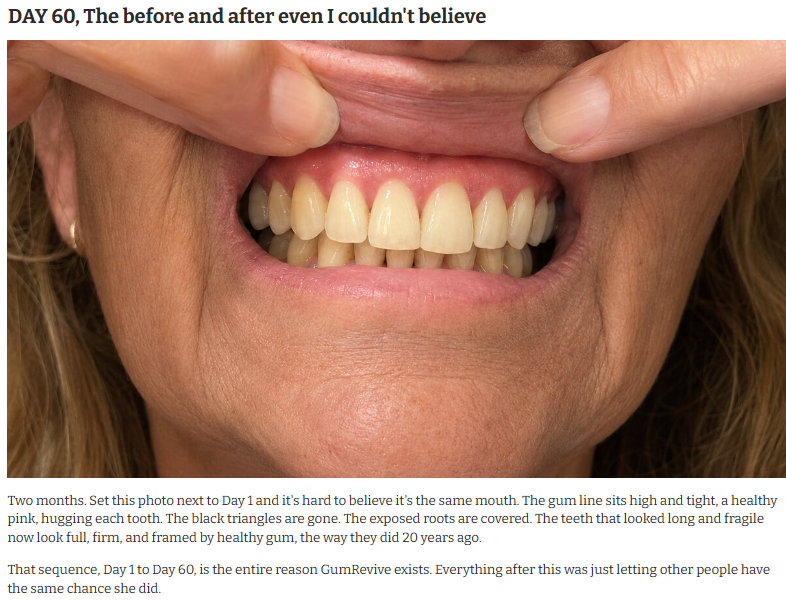
The bleeding stopped. The angry red and purple tissue turned a healthy pink. Pocket depths measured smaller. People who'd been told they were headed for grafts and extractions were watching their gums firm back up, at home, in minutes a day.
That's when I knew this couldn't stay locked inside a clinic or a study.
It's called GumRevive.
GumRevive is a simple, hands-free oral device that delivers the same red and infrared light therapy I used in my own dermatology clinic, now adapted for your gums and made for home use, in just 12 minutes a day.
You place it in your mouth. You gently bite down. You press one button. And you relax while it works.
No surgery. No grafts. No needles. No dentist appointment. No recovery.
Just the two exact wavelengths we spent all those months perfecting, 630nm red to calm and feed the gum line, 850nm infrared to rebuild the collagen underneath, delivered right where they need to go.
Used daily, it targets the actual cause of recession, collapsing collagen, instead of just rinsing the surface and hoping.
And the results people describe follow the same pattern, almost every time:
- First, the bleeding stops, often within days
- Then the color changes, angry red or "dark purple" gums turn a healthy pink
- Then the firmness returns, teeth that felt loose start to feel solid again
- And finally, the moment that makes it all real: your hygienist looks in your mouth and asks what you've been doing differently
THE FIRST PERSON I GAVE IT TO WAS MY MOTHER
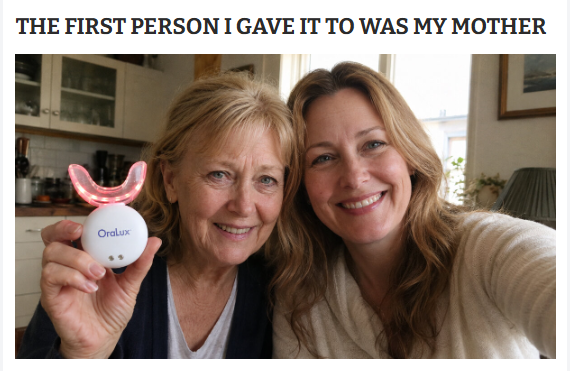
Before anyone else in the world tried GumRevive, my mother did.
The same woman who called me crying. The one who'd been told she'd "probably need implants" and that her gums would never come back.
I asked her to do just one thing: use it for twelve minutes a day, every day, and let me photograph her gum line along the way.
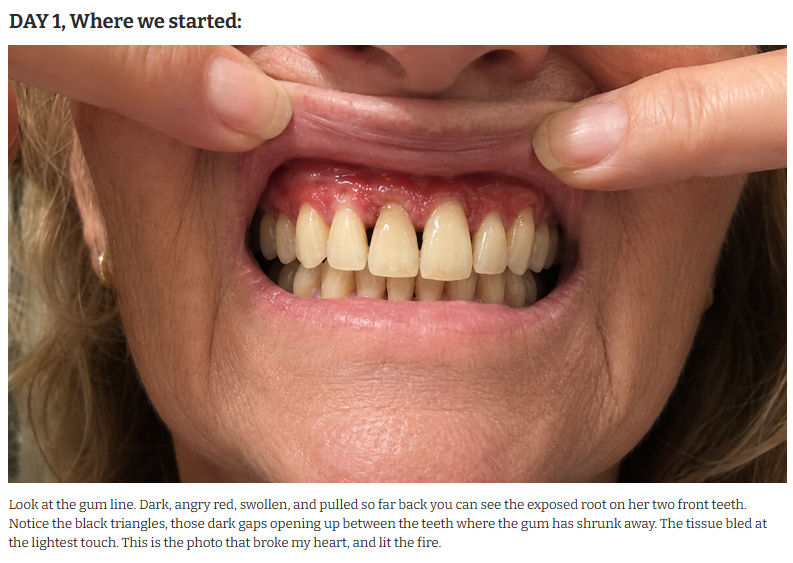
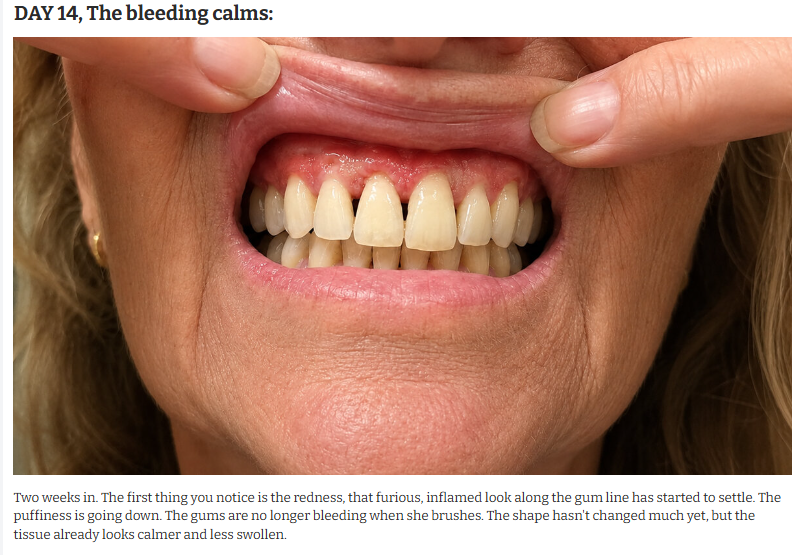
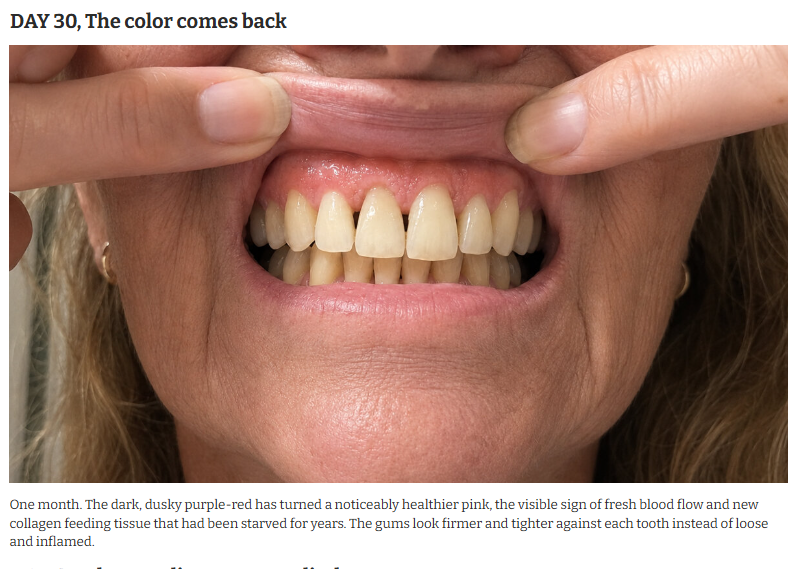
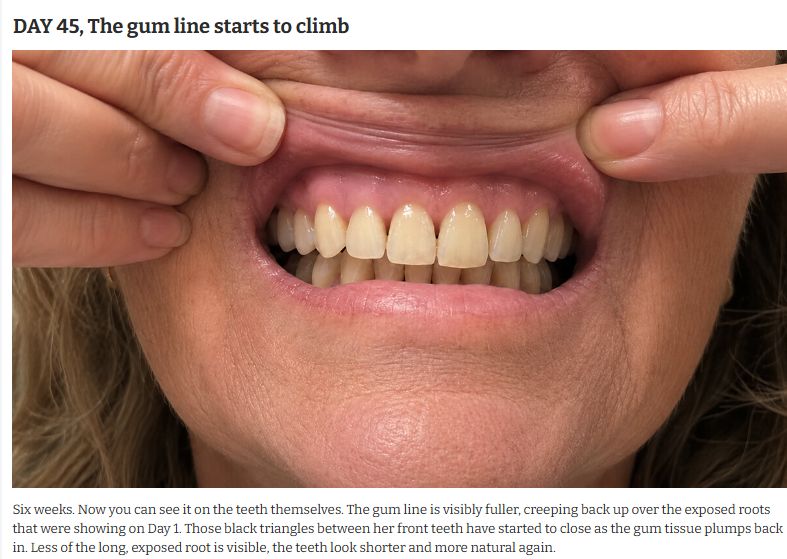
Here's exactly what we saw.